When Standard Drain Clearing Fails: Desentupidora Horto Florestal vs. Emergency Alternatives
By the end of this article you will know exactly what to do when plungers, drain snakes and off-the-shelf chemicals stop working — and you will have a clear decision path between waiting, improvising and calling a professional desentupidora Horto Florestal. The short answer: when a blockage returns within days, affects more than one fixture, or produces sewage backup, the usual method has already failed and mechanical equipment is the only reliable next step. This is a consultant-style walkthrough for a cautious client who wants to avoid paying twice for the same problem.
Why the Usual Method Fails in Horto Florestal Properties
Most households in this neighborhood start with a plunger, then a hand auger, then a bottle of chemical drain opener. That sequence works on fresh, localized clogs — hair in a shower drain, grease in a kitchen sink. It rarely works on the real cause of repeat blockages: hardened scale, roots, collapsed joints or accumulated sediment inside the lateral branch that connects the property to the street main. The method is not the problem; the diagnosis is.
Older buildings and houses with long horizontal runs are especially vulnerable. A hand snake may punch a small hole through the obstruction, water flows again, and everyone assumes the job is done. Two weeks later the same drain backs up, because the tool only created a channel through the blockage instead of removing it. That cycle is what turns a minor maintenance item into an emergency.
Signs That Tell You the Standard Approach Has Already Failed
- The clog returns within two to four weeks after being cleared.
- More than one fixture drains slowly at the same time — a sink and a floor drain, for example.
- Water gurgles in one drain when another is used.
- There is a persistent odor even after cleaning, suggesting standing waste in the line.
- Sewage backs up through the lowest drain in the property, which points to the main branch, not the fixture trap.
Any two of these signals together mean the obstruction sits deeper than a household tool can reach. At that point, continuing to pour chemicals is not just ineffective — it is risky, because caustic products can damage older PVC joints and create a much larger repair.
What Chemical Products Actually Do to the Pipe
Off-the-shelf drain openers rely on heat and caustic reaction. They work on organic matter near the surface of the clog, but they dilute quickly in standing water and lose strength before reaching the obstruction. Repeated use also attacks the pipe wall and the rubber seals at joints. A chemical that clears the drain today can be the reason the joint fails next year. For a cautious owner, that trade-off rarely makes sense beyond a single attempt.
Desentupidora Horto Florestal vs. Emergency Alternatives: A Practical Comparison
Once the household method is off the table, the realistic options are: call a general handyman, rent equipment and attempt it yourself, wait for the problem to worsen, or hire a specialized desentupidora Horto Florestal São Paulo SP. Each has a different cost profile, risk level and time to resolution. The table below compares them on the dimensions that actually matter to a property owner.
| Option | Typical outcome | Main risk | Best suited for |
|---|---|---|---|
| Handyman with a manual snake | Partial clearing, often temporary | Damage to pipe interior; no diagnosis | Simple, single-fixture clogs |
| DIY equipment rental | Variable; depends on operator skill | Injury, pipe breakage, no accountability | Confident owners with short runs |
| Waiting for it to clear | Almost never resolves a main-line blockage | Water damage, contamination, higher final cost | Never recommended |
| Specialized desentupidora with hydrojetting | Full removal and inspection | Low, when the provider is qualified | Repeat clogs, main lines, sewage backup |
The comparison is not really about price per visit. It is about how many visits you end up paying for. A cheap partial clearing that fails twice usually costs more than a single professional intervention with the right equipment, and it adds the cost of water damage and lost use of the property.
Why Hydrojetting Changes the Outcome
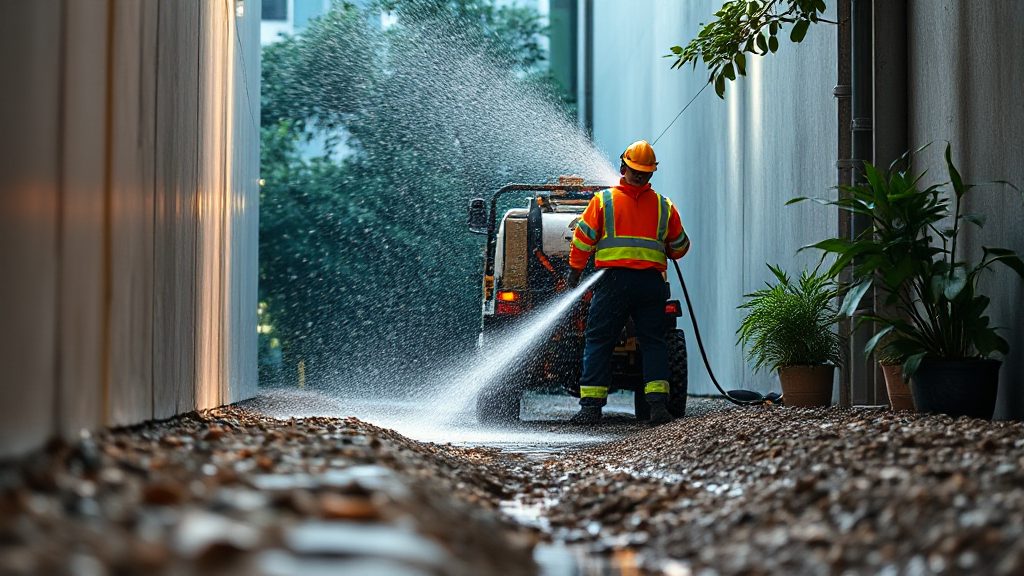
Hydrojetting uses high-pressure water directed through a specialized nozzle to scour the full inner circumference of the pipe, removing grease, scale, sediment and root intrusion rather than punching a hole through it. For main lines and long horizontal runs, this is the difference between clearing a symptom and removing the cause. It is also the step that most household tools simply cannot replicate, no matter how many times they are used.
For properties with septic systems rather than a direct connection to the public network, the failure mode is different. A slow drain may indicate a full tank or a saturated drain field, not a pipe obstruction. In that case, clearing the pipe without addressing the tank wastes the service call. A qualified provider will check which system the property uses before choosing equipment, which is one reason to confirm the scope of work before anyone arrives.
What a Professional Visit Should Include
- A short interview about when the problem started and which fixtures are affected.
- Visual inspection of accessible cleanouts, traps and the lowest drain point.
- Selection of method — cable machine, hydrojetting or both — based on the obstruction type.
- Verification that flow is restored across all connected fixtures, not just the one that was blocked.
- Recommendations for prevention, including what not to put down the drain.
If a provider skips the verification step, you have no way to know whether the line is genuinely clear. Ask for it explicitly. It takes minutes and prevents the callback.
Making the Decision: A Step-by-Step Action Plan for Cautious Owners
The practical path is to stop improvising once the failure signals appear, document what you have already tried, and book a specialized desentupidora em Horto Florestal São Paulo SP with a clear description of the symptoms. That single sequence avoids the most common and most expensive mistake: repeated partial fixes that never address the root cause.
Before You Call
Write down the timeline: when the problem first appeared, what you tried, and whether it improved temporarily. Note which fixtures are affected and whether the backup worsens after heavy water use. If you have a cleanout cap accessible on the property, confirm its location so the technician can go straight to it. This preparation shortens the visit and reduces the chance of unnecessary exploratory work.
Also decide in advance what your priority is: lowest immediate cost, fastest resolution, or a durable fix. These lead to different choices. A cautious client usually wants the durable fix, and that means asking whether the provider uses mechanical equipment and whether they verify flow afterward.
Questions to Ask the Provider
- Which method will be used for this type of blockage, and why?
- Is the visit available outside business hours if the situation worsens?
- How is the result verified before the job is considered complete?
- What is the recommendation if the obstruction turns out to be structural?
Clear answers to these four questions separate a diagnostic service from a quick clearing. If the answers are vague, that is your signal to keep looking.
After the Service: Preventing the Repeat
Once the line is clear, the goal shifts to keeping it that way. Grease should never go down the kitchen drain, and paper products other than toilet paper should stay out of the toilet. For properties with mature trees nearby, a periodic check of the lateral line is cheaper than an emergency call. Prevention is the only intervention that lowers the lifetime cost of a drainage system.
Keep the service record — date, method used, and any observations about pipe condition. If the same line blocks again within a year, that record tells the next technician exactly where to look and prevents starting from zero.
The Closing Action
If your drains have already defeated the usual method, the decision is not whether to escalate — it is how quickly. Document the symptoms, ask the four questions above, and book a provider that uses mechanical equipment and verifies the result. That is the shortest path from a recurring blockage to a property that drains normally again, and it is the outcome this entire plan is built around.