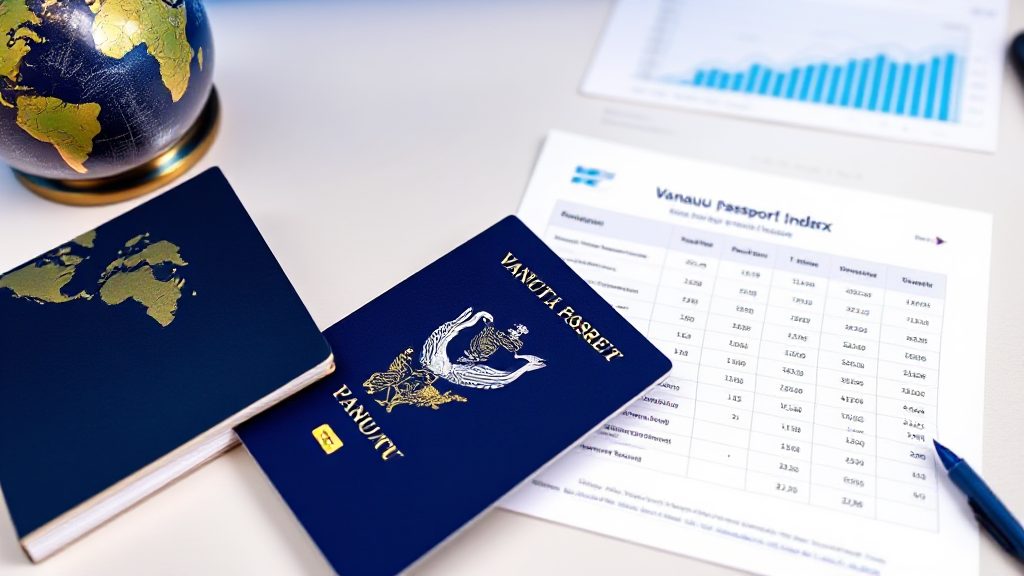
What a Vanuatu Passport Really Costs: Contribution, Due Diligence, and the Rest
The headline figure most people hear when they first look into Vanuatu citizenship is a single number: the government contribution. That number is real, and it is the largest single line in the budget, but it is not the whole bill. Anyone who budgets only for the contribution and then discovers the due diligence fee, the professional fees, and the incidental costs halfway through the process is working with an incomplete picture. The purpose of this breakdown is to separate those lines so the total is visible before any commitment is made.
For a structured comparison of how different organisations rank the Vanuatu passport and why those rankings diverge, https://vanuatupassportindex.com/ is a useful reference point. It explains the methodology differences behind the numbers, which matters because the cost picture and the mobility picture are usually evaluated side by side. This article stays on the money side and treats each cost category as its own line item.
The Government Contribution: The Headline Number and What It Actually Covers
The contribution is the payment made to the state under the citizenship programme. It is the figure quoted in programme documentation and the one most often repeated in summaries. It scales with the number of applicants: a single applicant pays less than a couple, and a family of four pays more than a couple. This is not a fee for a service in the ordinary sense; it is a contribution to national development, and it is structured in tiers that reflect the number of dependants included in the application.
Two practical points are worth flagging. First, the contribution is usually paid in a single tranche at a defined stage rather than spread across the process, which means the cash-flow requirement is concentrated. Second, the contribution is not the same as the total government take. There are separate statutory and administrative amounts that sit alongside it, and treating the contribution as the full government cost is the most common budgeting error.
It also helps to understand what the contribution does not cover. It does not cover the background checks, the agent’s work, translations, courier costs, or travel if any is required. Each of those sits in its own category below, and each has its own payment timing.
Due Diligence and Application Fees: The Non-Negotiable Layer
Due diligence is the vetting layer. It is the process by which authorities examine the applicant’s background, source of funds, and general profile before citizenship is granted. The fee attached to it is typically per applicant and is payable regardless of outcome in most programme structures. This is the category where applicants are most often surprised, because the amount is fixed and does not scale down for dependants in the same way the contribution does.
Alongside the due diligence fee there are application and processing fees. These are administrative charges for handling the file, and they are usually smaller than the due diligence amount but not trivial. In a family application, these per-person charges multiply quickly, and they are the reason a couple’s total can be materially higher than double a single applicant’s figure in some cost lines.
The key characteristic of this layer is that it is largely non-refundable. Once vetting begins, the work has been performed, and the fee is consumed. That distinction matters for the refundable versus non-refundable section further down.
Professional Fees: What the Agent, Lawyer, and Adviser Actually Charge
Most applicants do not file directly. They work through a licensed agent, and often through a lawyer or adviser as well. These professionals charge for their time and for the risk they carry in submitting and representing the application. Professional fees vary widely by provider, by jurisdiction of the provider, and by the complexity of the file. A straightforward single applicant with clean documentation will pay less than a family with multiple source-of-funds streams and prior residencies in several countries.
It is worth separating two things inside this category. The first is the agent’s programme fee, which is usually quoted as a package. The second is ancillary professional work: notarisation, certification, legal opinions, and any advisory work on structuring. The package fee is visible up front; the ancillary work is where budgets drift. Asking for a written scope that lists what is included and what is billed hourly is the single most effective way to control this line.
Professional fees are typically paid in stages: a retainer at engagement, a milestone payment at submission, and a final payment at approval. That staging is useful for cash-flow planning, but it also means the total is not always obvious from the first invoice.
Incidental Costs: Documents, Translations, Travel, and Timing
Incidentals are the category that quietly adds thousands to a budget. They include certified translations of birth certificates, marriage certificates, police clearances, and any other civil documents. They include courier costs for original documents moving between countries. They include notary and apostille fees, which vary enormously by jurisdiction. They include passport photographs, medical certificates where required, and bank charges for international transfers.
Travel is the largest potential incidental. Depending on the programme’s requirements and the applicant’s location, there may be a need to travel for an interview, for oath-taking, or for document collection. Even where travel is not mandatory, many applicants choose to visit, and that cost sits outside every official fee schedule.
Timing also has a cost dimension. A slower process means more months of professional time, more courier runs, and more exposure to currency movement if fees are quoted in a foreign currency. Building a small contingency into the incidental line, rather than treating it as a rounding error, is the realistic approach.
Running Total, Refundable Versus Non-Refundable, and What to Verify
Described as a running total rather than a fixed spreadsheet, the structure looks like this. Start with the government contribution as the base. Add the due diligence fee per applicant. Add application and processing fees per applicant. Add professional fees as a package plus any ancillary legal work. Add incidentals for documents, translations, couriers, and notarisation. Add a contingency for travel and currency movement. The sum of those lines is the realistic budget, and it will always exceed the headline contribution figure. The gap between the two is not a scam or a hidden charge; it is simply the difference between one line and the whole bill.
The refundable versus non-refundable split is where applicants should focus their questions. Contributions are generally non-refundable once the application is submitted and processing has begun, though programme terms vary and should be read carefully. Due diligence and application fees are almost always non-refundable because the work is performed on submission. Professional fees are partly refundable depending on the engagement letter: a retainer may be refundable if the file has not been submitted, while milestone payments tied to completed work are not. Incidental costs such as translations, couriers, and notarisation are spent money and are not recoverable.
The practical takeaway is to ask for the refund policy in writing at the point of engagement, not after a problem arises. A provider who can explain clearly which amounts are recoverable and under what conditions is a provider who has thought about the client’s downside. For a broader view of how the Vanuatu passport is assessed across different indices, and how those assessments interact with programme terms, the comparison material at https://vanuatupassportindex.com/ is worth reading alongside the cost documents. Cost and mobility are two sides of the same decision, and neither should be evaluated in isolation.
Frequently Asked Questions
Is the government contribution the same as the total cost?
No. The contribution is the largest single line, but due diligence fees, application fees, professional fees, and incidentals sit on top of it. A realistic budget adds all of those categories plus a contingency.
Which costs are non-refundable?
Due diligence and application fees are generally non-refundable once processing begins. Contributions are typically non-refundable after submission, and incidental costs such as translations and couriers are spent money. Professional fees depend on the engagement terms and how far the file has progressed.
Do costs scale with family size?
Yes, but not uniformly. The contribution scales in tiers by number of applicants, and per-person fees such as due diligence and application charges multiply. Professional fees may scale less than proportionally because much of the work is shared across the family file.
How much contingency should be built in?
A contingency covering currency movement, additional document certification, and possible travel is prudent. The exact amount depends on the applicant’s location and document profile, but treating incidentals as zero is the most common budgeting mistake.